Routine3 min read
Staying on GLP-1 treatment in real life: why people stop
In real life, many people stop GLP-1 treatment, like Ozempic and Mounjaro, earlier than planned. The main reasons, and what studies link to staying on it.

Clinical trials and real life are different
In clinical trials, the great majority of people stay on treatment until the end. In real life, they don’t. In the US, among 4,066 adults without diabetes who started a GLP-1 for obesity, 32.3% were still on treatment a year later. In one American health system, among 393 people who took semaglutide for obesity, 44% were still on it at 12 months.
These numbers come from observational studies: they show associations, and don’t prove cause and effect. Some of them have authors linked to the digital platforms studied or to the manufacturers.
Why people stop
In a digital program in Australia, with 5,604 people, the most common reasons for leaving were not being able to get the medication they wanted (43.7%), cost (26.2%), dissatisfaction with results (9.9%) and dissatisfaction with the service (7.2%).
In a small analysis of 60 public reviews, stomach and bowel complaints appeared in 62% of them, but didn’t significantly change the decision to continue. What weighed most was not seeing results and having other kinds of side effects.
In other words: beyond side effects, access, cost and the feeling that the treatment isn’t working all play a part.
What goes along with staying on treatment
None of these findings is a guideline. They’re what real-world data show so far:
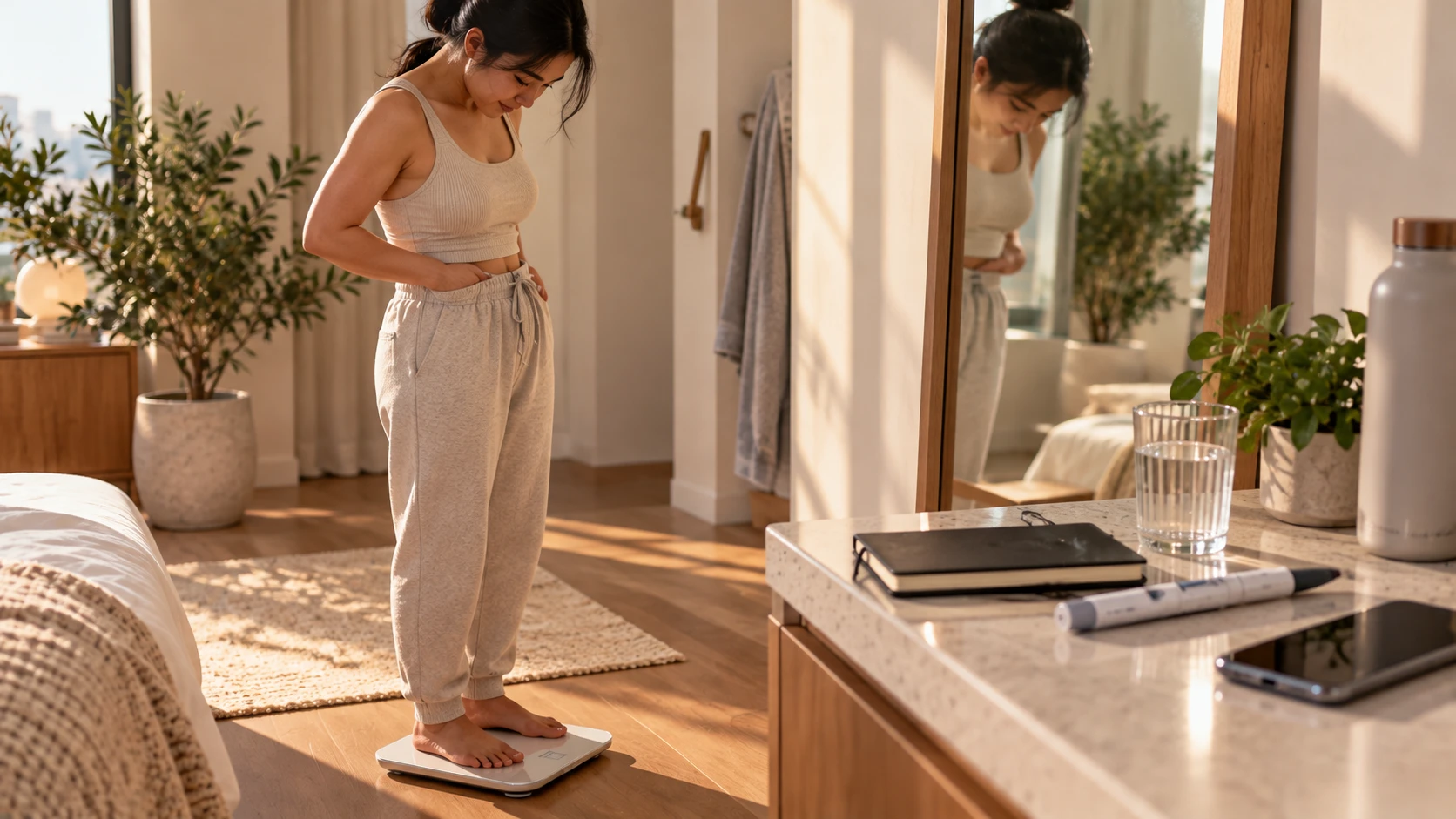
- Weighing yourself once a week, consistently, was associated with staying on treatment longer. Weighing yourself very often in the first month, on the other hand, was associated with stopping.
- Very fast loss at the start was associated with dropping out later. It’s not something to speed up.
- In France, among 191 adults followed through a questionnaire platform, 59.5% of those who didn’t use it stayed on treatment, compared with 71.9% of those who used it partly and 79.5% of those who completed it.
- In digital programs, talking with the program’s coach was also associated with staying on longer.
What to do with this
A slow week and a plateau are common, and weight swings from day to day with water, salt and your bowels. The feeling that “it’s not working” is one of the reasons most tied to stopping, so it’s worth looking at the trend over the weeks, not the number of the day.
If what weighs on you is cost, not being able to get the medication or discouragement with your results, bring it to your care team, who can help find a way forward. The dose, going up or down, is always your prescriber’s decision.
And if you’re thinking of stopping, talk it over first. In the studies where people stopped semaglutide or tirzepatide, much of the weight lost came back, though on average not all of it, and in one of them, measures like blood pressure and blood sugar also returned close to where they started. That doesn’t mean no one can stop: it means that whether and how to stop is decided with your care team.
A long-term treatment
In 2025, the World Health Organization published its first guideline on GLP-1 for obesity. It treats the medication as a long-term treatment and as part of broader care, with nutrition, physical activity and professional support.
In Morphi
We show your weight as a trend, not a single day’s swing, and you note your questions and obstacles as they come up, to bring in the one-page summary for your appointment. We don’t pressure you, and we don’t suggest changing your dose.